Daily Trojan
As the familiar neon sign of the Tower Hill Tube station glowed brightly against the backdrop of the setting sun, a male figure loomed ominously in the shadows. He wore a cavernous trench coat and a brown fedora, giving me the distinct impression that it had been lifted straight out of an Indiana Jones movie.
The darkness — coupled with the intermittent sprinkles and the howling wind — made the man, who managed to make the garb of an archaeological professor intimidating, appear as though I should rush back home and snuggle beneath my comforters.
It didn't help that just minutes before I had dashed into a taxi to try and meet him on time, all along thinking that I was setting myself up to be spooked.
Wind-blown and with my stomach in knots, I looked around in a frazzled daze. A large group had already assembled around the mysterious figure, and as I neared, his face came into view. The menacing shadow-lurker turned out to be Donald, our guide on a Jack the Ripper walking tour.
Donald Rumbelow, upon closer inspection, is not the fearsome character I had aggrandized from afar. His monstrous size could be attributed to the plastic stool he stood on, and his sinister appearance was more from a lack of sleep and an overactive imagination than any real threat.
The anticlimactic buildup to our first encounter was the first of many that would continue throughout our two-hour journey.
That night, proudly resting atop his woolly, multicolored scarf was a prestigious Blue Badge, a fixture awarded by the Institute of Tourist Guiding that lent him additional credibility that had nothing to do with the bookish spectacles sitting on his face.
The process to become an official Blue Badge Guide in London is rigorous. Guides undergo training courses, that take approximately two years to complete. And that's in addition to all the exams and mock tours they have to pass.
Rumbelow, having written two books on the infamous prostitute-murderer, is indeed very knowledgeable. But as he steered us a few steps to the side — centering our view squarely on the Tower of London — he prefaced his story by revealing that the building behind him had nothing to do with the Jack the Ripper murders.
With a somber look and an official tone, he told our group of about 50 to 60 walking enthusiasts that the fortress, known for a history of torture and gruesome executions, was just a theatrical backdrop for the violence to come.
From there, we moved outward through the cobbled streets on which Ripper committed his gruesome crimes. His name, a pseudonym describing the method in which he killed his victims, is attributed to a fake letter the media claimed to have been written by him. Despite its being based on a false source, however, the name stuck.
In 1888, Ripper was able to move between the City of London and Scotland Yard jurisdictions. In doing so, he evaded both forces by scattering the murders throughout each territory.
Because the two police forces were not allowed to investigate past their areas of authority, and they lacked the communication necessary for true cooperation, Ripper was able to pick up his victims wherever he pleased.
As we followed in Ripper's footsteps, tracking back and forth between the invisible boundary lines, Rumbelow intertwined stories of the five murders — all East End prostitutes, most in their 40s — with a dramatic air, revealing the attitudes and ineptitudes of law enforcement at the time.
However, just as he began describing Ripper's narrow escape from two incoming search parties, a heckler rode by on his bike shouting indecipherable obscenities, breaking the mood that Rumbelow had tried so hard to craft.
The highlight of the walk came when Rumbelow, while describing Jack the Ripper's second victim in one night, asked for a volunteer. Silence seeped through the crowd, until a brave woman sporting a sleek ponytail and plastic-framed glasses offered her services.
In the confines of Mitre Square, he raised her hand high above her head and proclaimed, "This is the spot to where the body of Catherine Eddowes was found!"
Yet the streetlights shining brightly on the redeveloped buildings and the once narrow passageway widened to the width of a monster truck proved to be insurmountable barriers to imagining what was once a prostitute's nightly haunt.
The story that ended the tour, however, was the account of Jack's first victim, Polly Nichols, whose last known words as she confidently strolled out of the lodge house — a cheap hotel where many of the destitute stayed — were, "I'll soon get my doss money! See what a jolly bonnie I've got now?"
Back in the 1880s, prostitutes were cheaper than one night at a lodge house, but Nichols believed her hat would attract enough customers to put her up.
She did manage to get the attention of a man. Unfortunately, that man was Jack the Ripper. And we all know how that ended up.
Jack the Ripper - eBook for sale
docstoc
Jack the Ripper
By: John Eddleston
Publisher: ABC-CLIO
Published on: 10/10/2001
Print ISBN: 9781576074145
Available Formats: PDF
Requires: Adobe Digital Editions
DownloadNote: You will need to download and Install Adobe Digital Editions in order to open this eBookDescription
Now readers can try solving this long-standing mystery for themselves. At their disposal in this new encyclopedia is a list of all the likely victims, with details about the evidence linking their deaths to Jack the Ripper.
Not merely a collection of interesting facts, this book compiles and connects a myriad of facts, myths, evidence, eyewitness accounts, and police investigations.T
he encyclopedia includes a list of more than 100 witnesses and what each one saw, descriptions of the locations where the murders took place and the police officers involved in the investigations, contemporary newspaper accounts, and psychological profiles and physical descriptions of The Ripper.
In the final chapter, John J. Eddleston, author of numerous books and articles on crime, reveals his own deductions about "whodunnit," narrowing the list of suspects to one man.
Jack the Ripper
By: John Eddleston
Publisher: ABC-CLIO
Published on: 10/10/2001
Print ISBN: 9781576074145
Available Formats: PDF
Requires: Adobe Digital Editions
DownloadNote: You will need to download and Install Adobe Digital Editions in order to open this eBookDescription
Now readers can try solving this long-standing mystery for themselves. At their disposal in this new encyclopedia is a list of all the likely victims, with details about the evidence linking their deaths to Jack the Ripper.
Not merely a collection of interesting facts, this book compiles and connects a myriad of facts, myths, evidence, eyewitness accounts, and police investigations.T
he encyclopedia includes a list of more than 100 witnesses and what each one saw, descriptions of the locations where the murders took place and the police officers involved in the investigations, contemporary newspaper accounts, and psychological profiles and physical descriptions of The Ripper.
In the final chapter, John J. Eddleston, author of numerous books and articles on crime, reveals his own deductions about "whodunnit," narrowing the list of suspects to one man.


Conspiracy Walking Tours in London on the trail of Jack the Ripper
Suite101.com
Launched in April 2010, the London Conspiracy Walks are very much the new kid on the block and this is perhaps what gives them the edge over their competitors.
Though there are many walks that offer fascinating subject matter such as Jack the Ripper and Sherlock Holmes, or familiar book and films sets such as James Bond, Harry Potter and the Da Vinci Code, they are predictable, bland and, quite frankly uninspiring. London Conspiracy Walks on the other hand aim to intrigue.
Advertised as 'The Most Thought-provoking Tours in London,' the Conspiracy walks certainly live up to their billing, with each subject matter featuring some element of conspiracy or conspiracy theory.
Needless to say it makes for an interesting tour of London and gives participants plenty of food for thought long after the tour has ended.
Read more at Suite101:Conspiracy Walking Tours in London http://england-travel.suite101.com/article.cfm/conspiracy-walking-tours-in-london#ixzz0lUrsPYwd
Launched in April 2010, the London Conspiracy Walks are very much the new kid on the block and this is perhaps what gives them the edge over their competitors.
Though there are many walks that offer fascinating subject matter such as Jack the Ripper and Sherlock Holmes, or familiar book and films sets such as James Bond, Harry Potter and the Da Vinci Code, they are predictable, bland and, quite frankly uninspiring. London Conspiracy Walks on the other hand aim to intrigue.
Advertised as 'The Most Thought-provoking Tours in London,' the Conspiracy walks certainly live up to their billing, with each subject matter featuring some element of conspiracy or conspiracy theory.
Needless to say it makes for an interesting tour of London and gives participants plenty of food for thought long after the tour has ended.
Read more at Suite101:Conspiracy Walking Tours in London http://england-travel.suite101.com/article.cfm/conspiracy-walking-tours-in-london#ixzz0lUrsPYwd
The Real Mystery - Why do today's writers try to associate Sherlock Holmes and Jack the Ripper with Masonry?
Masons of Texas
The Real Mystery
Why do today's writers try to associate Sherlock Holmes and Jack the Ripper with Masonry?
From THE NORTHERN LIGHT--August 1991 by C. DeForrest Trexler
"I say, Holmes, what is this mumbo jumbo?"
This line spoken by an incredulous Dr. John Watson (played by the actor James Mason) as Sherlock Holmes (Christopher Plummer) gives Masonic signs and proceeds to engage London's Police Commissioner (Anthony Quayle) in a mysterious hand grip, which Holmes explains to be the secret mode of recognition among Masons of the 33 degree.
The scene, even more startling to real life Masons than to the play actor Dr. Watson, appears in the 1978 motion picture Murder by Decree.
It piques curiosity. What connection did the world's most famous, albeit fictional, detective have with Freemasonry?
In a later scene the question is answered for us, at least insofar as the screen drama is concerned. Holmes admits that he is not a member of the Society of Freemasons, but that he has made a study of its secret rituals as he has of many other arcane subjects, ranging from varieties of poisons to blends of tobacco.
The film progresses to a climatic scene in London's Freemason's Hall, where Holmes confronts three leading figures of the British government, who also are identified as prominent Freemasons. (The spokesman for the three, the Prime Minster, played by John Gielgud, in real life never was a Mason.) Holmes accuses the three of conspiracy in obstruction of justice. The case in point is the grisly murder of five prostitutes, crimes which actually were committed in London's ghetto-like East End during the autumn of 1888 by an assailant known to contemporaries and posterity only by the ghoulish sobriquet "Jack the Ripper."
The theory advanced by Holmes on the cinema scene is that the infamous Jack was not simply a psychotic, as generally supposed at the time and since. He charges that the notorious killer was a confident of the Royal Family whose motive was to prevent disclosure of a scandal which he believed would endanger the British monarchy. More to the point, the killer was a Freemason. Therefore, his fellow Masons among the police and the highest levels of government "were sworn to protect him in his criminal intent." M asonic affiliation is the explanation given in Murder by Decree as to why the killer, called "Jack the Ripper," never was apprehended and why his identity has remained a mystery for more than a century.
A possible Masonic connection was one of many theories explored in a six-part series, The Ripper File, which aired on BBC television in 1974. The BBC script was published in book form under the same title and is listed among the credits of Murder by Decree. As the television producer has pointed out, however, the series gave little more than a passing mention to the possibility of a Masonic conspiracy and discounted the theory for lack of evidence.
There are three purported bases for the Masonic connection theory, all of them circumstantial and all of them contrived.
First, it is alleged that the Ripper's victims were killed and mutilated in such a way as to imitate the ancient penalties of the symbolic degrees. True, the throats of the victims had been cut. But this is a common and expedient method for murder, slaughter, or ritual sacrifice. Beyond that, the indescribable butchery inflicted upon the Ripper's victims reflects a bestially having no resemblance to the symbolic penalties of Masonic ritual.
Moreover, the purpose of the penalties in Masonic ritual is to bind the initiate to his obligation. The initiate affirms the seriousness of his fraternal commitments by invoking a symbolic penalty upon his own head should he betray his trust. Nowhere does the ritual of Freemasonry suggest the infliction of penalties or retribution upon non-Masons, whatever their offenses might be. Thus, the study which the Sherlock Holmes of the film claimed to have made of Masonic ritual seems to have been as superficial as his supposition of the Prime Minister's Masonic affliction was erroneous.
Secondly, a cryptic message concerning the "Juwes" was found scrawled in chalk on a wall near the scene of one of the Ripper's murders. Proponents of a Masonic connection argue that this was not an antisemitic slogan as commonly supposed, but a reference to the three assassins of the Hiramic legend. On the other hand, if a Mason committed the crimes, why would he leave such a clue incriminating the fraternity and why at the scene of only one of the five murders?
Thirdly, the police officials responsible for the inconclusive investigation of the Ripper murders were known to be active Freemasons. Can it be inferred from the mere fact of their Masonic association that they were unsuccessful in apprehending the murderer because they were shielding one of their own? Can a criminal conspiracy be inferred simply from a common interest and association? These questions should be rhetorical. Unfortunately, controversy in recent years over the extent of Masonic influence among the Masonic influence among the British police has led some to give credence to the possibility.
"The insidious effect of Freemasonry among the police" was a theme articulated by Stephen Knight in Jack the Ripper: The Final Solution, published in 1976. Knight began with the slender strands of supposition which The Ripper File had unravelled, but then discarded, weaving them into a conclusion that a Masonic conspiracy was not just an unsubstantiated theory, but incontrovertible fact. Fortunately, Knight's credibility is compromised by his rabid anti-Masonry. Among the "facts" to which Knight alludes gratuitously are the Masonic murders of William Morgan and Wolfgang Amadeus Mozart.
Subsequently, the very individual who had proposed the Masonic connection to BBC researchers confessed that the implication of Freemasonry in the Ripper murders had been a hoax. That should have ended the matter. Unfortunately, the story that the television producers had nibbled upon with a grain of salt, Knight had swallowed whole. He persisted in the delusion until 1985, when a brain tumor took him to an early grave, a victim, some said, of still another Masonic conspiracy.
Very probably the reason why Stephen Knight and others like him have seized upon the notion of Masonic conspiracy as an explanation for the crimes of Jack the Ripper is for purpose of effect. What really concerns them is not the solution of that mystery, not what may have happen today if the power of government, especially law enforcement, is concentrated in the hands of men whose personal allegiance to the bonds of a secret society may take precedence over their public duty. It was much the same apprehension, rather than the disappearance of William Morgan, which fanned the flames
of anti-Masonry in America during the last century.
But why bring Sherlock Holmes into all of this?
It is perhaps an irresistible temptation to set the most famous sleuth of all time on the trail of the most infamous criminal to have eluded justice, especially since both (one in real life, the other in fiction) frequented the streets of London during the same space in time. Murder by Decree is not the only medium to have attempted this. Nevertheless, it is significant that the creator of Sherlock Holmes, Sir Arthur Conan Doyle, never succumbed to this temptation. In none of Doyle's four novels and 56 shor t stories which recount the adventures of Sherlock Homes, including encounters with the likes of the Mafia and the Ku Klux Klan, do we find the formidable talents of the master detective applied to solve the Ripper mystery which had baffled Scotland Yard. Although the Ripper murders coincided with the earliest Holmes stories, Doyle made no attempt to use the Ripper's notoriety to gain public acceptance when the success of his venture into detective fiction was far from assured.
Moreover, there is no basis in the works of Conan Doyle for recruiting his immortal character, as did the screenwriters of Murder by Decree, to provide a vehicle for a baseless expose and diatribe against Freemasonry. To be sure, many authors, playwrights, and screenwriters over the years have taken license in exploiting to their own ends the fame of Doyle's creation, one of the most universally recognized names in fiction, by placing him in new and different circumstances which Doyle never intended or cold have imagined. Consider, for example, the popular film series of the 1940's starring Basil Rathbone, which saw Sherlock Holmes combating Nazi spies and saboteurs.
Conan Doyle was born in 1859 into a devoutly Roman Catholic family and was educated in a Jesuit school. Entering the medical profession, he turned to writing as a means of supplementing the uncertain income of his fledgling practice. In 1887 he published A Study in Scarlet, which introduced Sherlock Holmes and his inseparable companion, John Watson, like Doyle himself, a struggling physician. A second Holmes novel appeared in 1890. It was not until the following year, however, when Doyle began to write a series of Holmes adventures for The Strand magazine, illustrated by the drawings of Sidney Paget, that his creation became a success. Indeed, he became a sensation.
Almost overnight, the tall, gaunt figure in the deerstalker cap and caped overcoat, never without pipe and magnifying glass, became a household word. (The admiring public appeared to overlook Holmes' cocaine habit.) Eccentric as Doyle created him, many readers were convinced that Holmes was a real person and the storied flat at 221B Baker Street actually existed.
Doyle, however, did not share the enthusiasm of the reading public. He tired of Holmes, wishing to devote his literary talents to historical adventures. Thus, at the end of 1893, he rid himself of Holmes, sending him to his apparent death in the Swiss Alps at the hands of his arch-enemy, Professor Moriarity. Holmes' demise brought a public outcry. Readers vented their disapproval by cancelling subscriptions to The Strand.
In time Doyle relented. The best known adventure of Sherlock Holmes, The Hound of the Baskervilles, appeared in 1901. Then, late in 1903, Holmes was resurrected in the pages of The Strand.
Despite his Catholic upbringing, or perhaps because of it, Doyle early in life rejected organized religion. He was repelled by what he saw as rigid dogmatism and divisiveness. He professed belief in a universal and beneficent God, who revealed himself to man through nature rather than through the church. Perhaps it was these beliefs and a desire to redefine his religious faith which led to Conan Doyle to become a Freemason. He was initiated in Phoenix Lodge No. 257 at Portsmouth in 1893. The Masonic experie nce does not seem entirely to have answered the need. Later in life he described himself as a "respectful agnostic" and experimented with spiritualism.
Five of Doyle's Sherlock Holmes works contain Masonic references. In no instance, however, is the fraternity a subject of the plot.
A Scandal in Bohemia, the first of the Holes stories to be published in The Strand, is reminiscent of Edgar Allan Poe's The Purloined Letter, just as Poe's detective hero, Dupin, often has been considered the literary precursor of Doyle's character. (Holmes typically, referred to Dupin as a "very inferior fellow.") Disguising himself as a groom to obtain information, Holmes explains to Watson that there is a "freemasonry among horsy men." The reference is not to Masonry as an organization, but employs the name as a common noun meaning fellowship, a recognized characteristic of the fraternity.
There are four occasions on which Holmes takes notice of an item of jewelry, which identifies the wearer as a Freemason. Once noted, no further mention is made of the fact. This does not mean, however, that the Masonic reference is trivial and of no account. Doyle invariably devoted much attention to Holmes' initial observations of a person's physical appearance, the detective is able to make an assessment of background, character, motivation, and veracity, which carries him a long way toward solution of the mystery before he stirs from 221B Baker Street.
Enoch Drebber, the murder victim in A Study in Scarlet, is described as having a "low forehead, blunt nose, and prognathous jaw...a singularly sinuous and ape-like appearance." He also is wearing a ring with a Masonic device. As the story unfolds, we find that Drebber was killed in revenge, meeting his just deserts for past misdeeds, which matched his sinister appearance. Much of A Study in Scarlet consists of a narrative of events during the early days of the Mormon settlement of Utah. Doyle obviously was using the excesses of Mormon theocracy to paint a melodramatic indictment of religious dogmatism. Writing six years before he became a Mason, was Doyle equating Freemasonry with the evils he perceived to exist in organized religion or with Drebber's clandestine villainies?
In The Red-Headed League, the second Holmes story to appear in The Strand, Jabez Wilson has been duped by a transparent scheme to leave his pawnshop each day so that criminals are free to use the premises to stage a robbery of a nearby bank. Wilson is described as being "obese, pompous, and slow," his clothing as frayed, ill-fitting, and "not over clean." He also is identified as a Freemason by a gaudy square and compasses pin. Again writing before his initiation into the craft, Doyle does not leave us with a very high opinion of the fraternity.
Quite a different image of Freemasonry is projected in The Adventure of the Norwood Builder. A young lawyer of modest circumstances, John Hector McFarlane, is charged with the murder of a wealthy client. Holmes finds his deductive powers taxed to the limit.
Ultimately, however, he discloses an ingenious scheme whereby the supposed victim has staged his own death and implicated McFarlane as an act of revenge against the lawyer's mother, who many years before had rejected him as a suitor. What made Holmes so convinced of McFarlane's innocence when the evidence seemed to convict him? Could it have been the fact that at their first meeting Holmes had noticed the young man's Masonic watch fob?
Lastly, in The Adventure of the Retired Colourman Holmes pays rare, if not unique, tribute to another detective by the name of Barker, going so far as to acknowledge him as a rival. Just incidentally, Barker's tie pin identifies him as a Freemason.
Doyle never tells the reader whether his detective hero is a Freemason. Nor are we told whether Holmes has made a study of Masonic ritual as is alleged somewhat unconvincingly in Murder by Decree. A Mason himself, Doyle may have been reluctant to reveal secrets of the Order or use his knowledge of Masonry for personal pecuniary gain. Nevertheless, by application of Holmes' own technique of deductive reasoning we can be reasonably certain that the master detective was not a member of the Masonic fraternity. Doyle did not intend for his creation to be the admirable image, which most people associate with Sherlock Holmes. He thought Paget's drawings were too idealized. The public reaction always perplexed him. Holmes' life-style was reclusive, his habits eccentric, his manner brusque and often patronizing, his attitude haughty and conceited, if not supercilious, and his interests obsessively preoccupied with but one field of endeavour-criminal inves tigation. No, it is unlikely that a man who shuns society, the da y-to-day concerns of his fellows, and the wider interests of mankind will be found upon the rolls of a Masonic lodge.
When, in the predawn hours, the timeless and tireless Sherlock Holmes routs the hapless Watson from his sleep and on to the fogbound streets of London with the familiar cry "The game's afoot," every widow's son can remain at heart's rest with the assurance that there is no Masonic connection.

Who was Jack the Ripper? - A Mirror investigation
Mirror.co.uk News
JACK THE RIPPER

..but who was he?
For such a disorganised killer, Jack the Ripper was horribly successful.
In just three months he butchered five women, cutting their throats and hacking and stabbing their bodies in a frenzy.
Then the most notorious murderer in history vanished - never to be arrested or identified.
Modern forensic analysis suggests the Ripper was fortunate not to be caught red-handed.
He struck in public taking the risk of being seen even as police and vigilantes patrolled London's East End.
But more than 120 years after he bathed Whitechapel's cobbles in blood, the man in the peaked cap remains unmasked.
Dozens of suspects - from princes to butchers - have been put forward. But there is still no proof any of them was the Ripper.
Though unable to identify him, the police in 1888 knew they were hunting an extraordinarily disturbed man. Dr Edward Bond, who examined the final victim, Mary Kelly, wrote of the killer: "The character of mutilations indicate that the man may be in a condition sexually that may be called satyriasis. It is possible that the homicidal impulse may have developed from a revengeful or brooding condition of the mind, or that religious mania may have been the original disease."
It will never be known if the Ripper had "satyriasis" - permanent sexual arousal - but the nature of his mutilations were plain to see.
The five women, all prostitutes in their 40s, had their throats cut deeply from behind before a ferocious attack on their wombs and reproductive organs.
The first, Mary Ann Nichols, was a drunk trying to earn fourpence to get a bed on the Friday night of August 31. Her body was found on Bucks Row, known as Durward Street today, with four inch and eight inch gashes from her throat to the neckbone. The inquest recorded that the "lower part of the person was completely ripped open".
Annie Chapman was next to die as she too tried to earn money for a night's lodging.
The flower-seller was found on Hanbury Street at 6am on Saturday, September 8, her throat cut to the spine. Part of her intestine had been thrown over her right shoulder and her womb and bladder "entirely removed".
Three weeks later the killer struck twice in 45 minutes.
Elizabeth Stride's body was found in an alleyway on Berner Street shortly after she left the Bricklayer's Arms. Her body was not mutilated because the killer had been disturbed by a man leaving a political meeting.
Israel Schwartz later told police he saw a man assault Stride but he ignored the incident believing it was a domestic dispute.
Angry at being interrupted, the Ripper found an alternative victim in Catherine Eddowes.
The mother-of-four had walked out of Bishopsgate police station, where she had been in the cells for drunkeness, at the same time as Stride's body was found. A few minutes later, Constable Watkins found her in Mitre Square "ripped up like a pig in the market". Eddowes' face and chest had been mutilated, her intestines cut out and thrown over her shoulder, her womb and left kidney removed. The killer had sliced off the tip of her nose and earlobes and slashed her cheeks too.
Again, there was a witness. Cigarette-seller Joseph Lawende's description of a shabby man, aged around 30, with fair skin and a peaked cap was almost identical to Schwartz's.
Despite the breakthrough Scotland Yard found nothing. The lack of blood-stained clothing led detectives to suspect the Ripper was being concealed by the Polish and Jewish community.
As the public demanded a suspect, a letter addressed "Dear Boss" was sent to Central News Agency. It promised to "clip the ladys ears off" and caused a sensation because Eddowes' ears were slashed.
As speculation mounted, a hoax postcard from "Saucy Jack" warned of a "double event" which some linked to Eddowes and Stride.
For a while the killer laid low but the dreadful urges returned soon enough.
On Friday, November 9, the Ripper murdered Irish widow Mary Kelly in her room off Dorset Street. He had made terrible use of their time alone. The Ripper slashed her neck to the bone, front, back and sides, hacked at her face and cut off her breasts.
He then emptied Mary's abdomen and placed her womb and kidneys under her head. Police found her intestines and spleen on the floor and the skin and muscle which had been carved from her thighs on the table.
And then the frenzied attacks stopped as suddenly as they had started.
More women were murdered in Whitechapel and the cases added to the Ripper file up to 1891.
But police doubted it was the same man - none of the victims was hacked open and mutilated as the "canonical" five.
Did the Ripper die? Perhaps he emigrated or was committed to an asylum. The mystery has never been solved. Hundreds of books have been written, dozens of DVDs produced and there are guided tours and undelievably Jack the Ripper toys.
Even the policemen cashed in publishing memoirs. The most infuriating was Sir Robert Anderson, assistant commissioner for CID, who claimed to have solved the crime.
He wrote: "I am almost tempted to disclose the identity of the murderer... but no public benefit would result from such a course."
Prof Wilson says THIS is the start of what we call serial killing and yet there is a direct link between The Ripper's five victims and the women strangled by Steve Wright in Ipswich nearly 120 years later. Most went out to work at night knowing a killer was on the loose but had no choice.
Jack was incredibly lucky not to get caught because he was, in my opinion, mentally ill. It would only have been a matter of time before the police caught him. I believe the Ripper was local to Whitechapel because he probably was not capable of planning a journey and people within his community, probably his family, covered for him when police investigated the murders.
Crimes Punishment Name: Unknown
PERIOD: 1888 KNOWN
VICTIMS: 5
SUSPECTED TOTAL: 7
PROFILE: Sex/hatred of women
AGE AT TRIAL: Never caught
SENTENCE: Never caught
SUSPECTS (INCLUDING THE KING'S SON!)
Aaron Kosminski A POLISH Jew, aged 33, who suffered from "mania" "delusions" and "hallucinations".
He once threatened to kill his sister and was declared insane by his family in 1888 on grounds of "self-abuse".
Scotland Yard chief Sir Melville Macnaughton said Kosminski had a "great hatred of women."
Francis Tumblety
AN American doctor who was gay, hated women, and was a notorious "quack". He was in London at the time and had an obsession with female reproductive organs. Tumblety fled to France in November 1888 following his arrest for homosexuality then returned to the US.
James Maybrick
A LIVERPOOL cotton merchant who confessed in his diary. Historians questioned its authenticity and the publisher admitted forging it. Forensic analysis showed the inks used were not avail-able until the 1970s and the handwriting does not match his will.
Seweryn Klowoski
HE was a Polish barber who later poisoned three wives and was hanged in 1903. He was known for his hatred of women and could well have been capable. But modern criminologists are doubtful about his guilt as serial killers rarely change a successful method of killing.
Prince Albert Victor
THE son of King Edward VII has been the subject of many conspiracy theories. In one, the Prince went mad after contracting syphilis from a prostitute. Others suggest he had an illegitimate daughter with a Catholic shopkeeper and Government agents killed those who knew.
Jack the Ripper London Sightseeing Tours and Walks
USA Today
Jack the Ripper London Sightseeing Tours and Walks
Jack the Ripper London Sightseeing Tours and Walks
- The unsolved crimes of Jack the Ripper have never ceased to capture the public imagination, and some of Whitechapel's alleys have changed little in the more than 100 years since Jack's reign of terror. Several different tours operate in Whitechapel, taking visitors for a walk along the very cobbles where blood was spilled and passing the Ten Bells Pub, where some of Jack's victims, and perhaps even the killer himself, were known to tip a pint.
-
Jack the Ripper Tour
Ripping Yarns, a London tour company, has been offering Jack the Ripper tours in Whitechapel since 1992. Each guide is a retired member of the British armed forces whose day job is leading tours at another famous London landmark. The tours leave every night at 6:45 from the Tower Hill underground station, except for the week between Christmas and New Year's. Feel free to book in advance, or you can just look for the tour guide holding the sign that says "Ripping Yarns." If your guide requests payment in advance, it is not a Ripping Yarns tour, as the company is confident about your willingness to pay after you experience the guided tour. Jack the Ripper Tour 355 Archway Road London, N6 4EJ United Kingdom +44-0-20-8341-6111 -
Jack the Ripper Walk
The most famous and highly acclaimed tour company in the city, London Walks offers a host of guided tours, including movie location tours, Harry Potter tours and ghost walks. Of all the London Walks, however, only the Jack the Ripper Walk was named a Gold Winner for Best Tourism Experience in the Visit London Awards of 2008. While all the tour guides are expertly trained, for the true Ripper experience you might want to check the website and join the tour when it is led by Donald. Donald is Donald Rumbelow, a former British police sergeant, crime historian, former curator of the London Crime Museum and author of two books on Jack's reign of terror. He also owns what is allegedly Jack's own knife! Other tour guides include several recognizable British television and film actors, and tours leave from the Tower Hill underground station every night at 7:30. Tours also leave at 3 p.m on Saturdays; there are no tours on Christmas Eve or Christmas Day. Jack the Ripper Walk P.O. Box 1708 London, NW6 4LW United Kingdom +44-0-20-7624-3978 jacktheripperwalk.com/index2.html -
The London Dungeon
The Dungeon is an attraction dedicated to bringing some of London's most gruesome history to life through live shows, scary rides and interactive exhibits. Among exhibits on the bloody history of surgery and the great fire of London, the Dungeon offers a trip back in time to 1888, when the city was gripped with fear. While not a substitute for exploring Whitechapel with a tour guide, a visit to the London Dungeon makes a great addition to any Jack the Ripper experience. The London Dungeon 28-34 Tooley St. London, SE1 2SZ United Kingdom +44-0-20-7403-7221 the-dungeons.co.uk/london/en/index.htm
Jack the Ripper - Very interesting theory from 1891
Jack the Ripper: Casebook
Bristol Times and Mirror
Wednesday 11 February 1891
OUR LONDON LETTER
I give a curious story for what it is worth. There is a West of England member who in private declares that he has solved the mystery of "Jack the Ripper." His theory - and he repeats it with so much emphasis that it might almost be called his doctrine - is that "Jack the Ripper" committed suicide on the night of his last murder. I can't give details, for fear of a libel action; but the story is so circumstantial that a good many people believe it. He states that a man with blood-stained clothes committed suicide on the night of the last murder, and he asserts that the man was the son of a surgeon, who suffered from homicidal mania. I do not know what the police think of the story, but I believe that before long a clean breast will be made, and that the accusation will be sifted thoroughly.
Bristol Times and Mirror
Wednesday 11 February 1891
OUR LONDON LETTER
I give a curious story for what it is worth. There is a West of England member who in private declares that he has solved the mystery of "Jack the Ripper." His theory - and he repeats it with so much emphasis that it might almost be called his doctrine - is that "Jack the Ripper" committed suicide on the night of his last murder. I can't give details, for fear of a libel action; but the story is so circumstantial that a good many people believe it. He states that a man with blood-stained clothes committed suicide on the night of the last murder, and he asserts that the man was the son of a surgeon, who suffered from homicidal mania. I do not know what the police think of the story, but I believe that before long a clean breast will be made, and that the accusation will be sifted thoroughly.
Nicole Richie Draws Inspiration From Jack The Ripper For Her Fall Winter Kate Collection
All Headline News
Los Angeles, CA, United States (AHN) - Nicole Richie was best known as the wise-cracking sidekick to Paris Hilton for a handful of seasons of “The Simple Life.” But the mother of two is getting serious about design, as evidenced by new looks she’s debuted as part of her Winter Kate Fall 2010 collection.
Richie, who is currently promoting the new collection at department stores across the country including Nordstrom, gave InStyle a first look. The ready-to-wear designs, which include flowing mini-dresses and even a peacock-print blazer, were inspired by an unlikely source.
“My main source of inspiration was this movie called ‘From Hell,’” Richie told InStyle about the collection. “It’s about the Freemasons and Jack the Ripper so it’s definitely about that time period. We have capes and cigarette pants, vests, jackets and blazers. There are cleaner lines and it’s a lot more simple.”
While she claims the looks were inspired by the 1800’s murder tale, complete with top hats, the collection maintains Richie’s chic bohemian style. The looks from the new Fall collection will debut in the coming months.
Other pieces from the Winter Kate collection, taken from the middle names of her daughter Harlow, are currently on sale at online stores like Bloomingdales and Kitson.
Los Angeles, CA, United States (AHN) - Nicole Richie was best known as the wise-cracking sidekick to Paris Hilton for a handful of seasons of “The Simple Life.” But the mother of two is getting serious about design, as evidenced by new looks she’s debuted as part of her Winter Kate Fall 2010 collection.
Richie, who is currently promoting the new collection at department stores across the country including Nordstrom, gave InStyle a first look. The ready-to-wear designs, which include flowing mini-dresses and even a peacock-print blazer, were inspired by an unlikely source.
“My main source of inspiration was this movie called ‘From Hell,’” Richie told InStyle about the collection. “It’s about the Freemasons and Jack the Ripper so it’s definitely about that time period. We have capes and cigarette pants, vests, jackets and blazers. There are cleaner lines and it’s a lot more simple.”
While she claims the looks were inspired by the 1800’s murder tale, complete with top hats, the collection maintains Richie’s chic bohemian style. The looks from the new Fall collection will debut in the coming months.
Other pieces from the Winter Kate collection, taken from the middle names of her daughter Harlow, are currently on sale at online stores like Bloomingdales and Kitson.
Whitechapel - The TV Series - A very novel examination of Jack the Ripper
TVSA
Show SummaryWhitechapel is a British television drama mini-series written by Ben Court and Caroline Ip and produced by Carnival Films and set in London 2008. A series of horrific crimes suggest someone is carrying out copycat Jack the Ripper murders 120 years after the killer struck. The clock is ticking as the case turns into a hunt for an old enemy, with three unlikely heroes at the centre. The mini-series premiered in the UK on ITV on 2 February, 2009. A second season was commissioned by ITV in September 2009, with the focus on the Kray Twins. Whitechapel premiered in South Africa on DStv's BBC Entertainment channel on Monday 22 June 2009, at 20h30. New episodes aired nightly, until Wednesday 24 June. A rebroadcast of Whitechapel premiered on BBC Entertainment on Monday 29 March 2010, at 22h30. Synopsis Set against the contrasting facades of Whitechapel, London, a series of bloody, tragic and impossible crimes suggest someone is carrying out copycat Jack the Ripper murders 120 years after the killer first struck. In a city under the constant surveillance of CCTV and safe in the knowledge that DNA evidence helps catch even the most dangerous criminal, this modern day Ripper still manages to recreate the slaughter with alarming accuracy while mirroring the red herrings and twisted idiosyncrasies connected to the original case. The murders are investigated by three unlikely heroes: Joseph Chandler (Rupert Penry-Jones), a fast-tracked, media savvy DI on his first big murder case; Ray Miles (Philip Davis), a front-line, hard-bitten DS, nearing retirement, now saddled with a boss who would rather talk about Emotional Intelligence than gut feeling; and Edward Buchan (Steve Pemberton), the expert on myths and legends behind unexplained or violent deaths: an eccentrically brilliant Ripperologist. A modern police force is fighting an old adversary; an adversary who was never caught. Our heroes have a race against time to prevent further bloodshed. This three part drama is produced by Marcus Wilson (True Dare Kiss, Life on Mars) for Carnival Films. It was written by Ben Court and Caroline Ip (Marian Again) and directed by SJ Clarkson (Mistresses, Life on Mars). Sally Woodward Gentle (Ruby in the Smoke, Waking the Dead) is Executive Producer. Episodes Episode 1 In the first episode, fast-tracker, DI Joseph Chandler, is posted to Whitechapel by Commander Anderson to lead the investigation into the murder of a young woman, the final step before promotion. However the case does not turn out as straightforward as Chandler had hoped. The victim, Cathy Lane, is found by Community Support Officer Mary Bousfield, bleeding to death, her throat cut, in the yard of a Board School. The Whitechapel squad – front-line, hard-bitten DS Ray Miles and DCs Kent, McCormack, Sanders and Fitzgerald – arrive at the scene after Cathy is pronounced dead and are less than pleased to hear of the imminent arrival of yet another new DI, a 'plastic', a 'paper policeman' who has no idea what he is doing. Chandler arrives, armed with the knowledge of his courses and text books, ready to solve his first murder. Miles' instinct tells him that the prime suspect is Cathy's husband, Rob Lees, a violent man with a history of assaulting his wife. However, when it turns out Rob has a 'ten copper alibi', the case becomes more complicated than it originally appeared. And when the pathologist, Dr Llewellyn, uncovers a nasty surprise that Cathy Lane's killer attempted to gut her, Chandler becomes increasingly aware that he is out of his depth: not only does he have a hostile squad to lead, but there is no evidence and no witnesses. Then Ripperologist, Edward Buchan, turns up to offer the theory that London has a copycat Jack the Ripper killer. Miles dismisses Buchan immediately as a crackpot Ripperologist and a timewaster, however Chandler, although sceptical at first, does realise that the case appears to share many similarities with the murder of Mary Ann Nichols in 1888. At a total loss as to how to progress the investigation and fearful there will be another murder, Chandler puts his career on the line and stages a major police operation in Whitechapel. All the squad go undercover and stake out the area around Brick Lane in Whitechapel near to where Jack the Ripper murdered his second victim, Annie Chapman in 1888. No one is convinced, least of all DS Miles... until the body of Alice Graves is found in the early hours – an exact recreation of the murder of Annie Chapman in 1888. It is now Chandler's job to track down the world's most infamous serial killer. Episode 2 As the team begins to accept Chandler's beliefs and methods, they are left with the problem of solving the unsolvable. In the second episode it is clear this case is no longer a straightforward murder that Chandler can wrap up quickly. He is summoned to see Commander Anderson and his superiors who are very concerned that London may have a Jack the Ripper copycat, and especially the impact of this leaking to the press. They tell Chandler he is on his own and must solve this case quickly. Having earned a small degree of grudging respect Chandler leads his squad as they begin researching Jack the Ripper, reading books and looking at DVDs, in an attempt to discover who the new Ripper may be. It is a race against time before he strikes again and they currently have nothing to go on – except what history tells them. Thanks to a witness and some helpful information from Ripperologist Buchan they have a prime suspect – a solider called Leary. Failing to get a confession out of him, they stake him out. It is the night when the next murder is due to happen in Mitre Square and all the team are tailing their chief suspect. However Leary, now clearly innocent, sets them up and they are ambushed by the media. By the time our team reach Mitre Square they are too late – the Ripper has struck again, this time murdering one of their colleagues, Community Support Officer Mary Bousfield. And not only this, Buchan the Ripperologist has been arrested at the scene. Was Chandler wrong to put his trust in Buchan? Is Buchan somehow assisting the Ripper? Miles is convinced Buchan is up to no good, and a visit to Buchan's home reveals to them the true extent of his Ripper obsession. When Miles receives some disturbing post at his home, it is clear that this has now become personal. Episode 3 In the concluding episode DS Ray Miles is sent the gruesome package containing half of Mary Bousfield's kidney along with a letter from the Ripper, an exact replica of the letter sent to George Lusk in 1888, along with half of Catherine Eddowes' kidney. The squad find the post office where the Ripper sent the package and see him on the CCTV, but are unable to identify him and they hit another dead end. Meanwhile Chandler decides to release Buchan as they have no evidence to hold him, but he puts a police tail on him. Buchan, his soul tortured, dramatically burns all his books in front of a press audience and denounces his life's work and theories in an attempt to stop the Ripper. But is this too little too late? And can the squad really trust Buchan and his theatrics as genuine? The CCTV footage of Mitre Square is more successful for the squad and leads them to Maduro's Health and Safety. They find evidence that proves Mary Bousfield was killed in one of Maduro's vans, driven by Antoni Pricha, the morgue man at the hospital. However when it becomes evident that the killer stole Pricha's identity, the squad draw another blank. All they have to go on is what happened in 1888: all they know is that Jack the Ripper's next victim was red-haired Mary Kelly, that she had fish and potatoes for her supper and the date she was murdered. Not a lot to go on... Chandler becomes increasingly obsessed and disturbed by feelings of personal responsibility. After much time, thinking and searching for the answer, he suddenly has a "eureka" moment, acts on his instincts and works out where the Ripper's flat is, but not before being attacked by the killer. In the Ripper's lair the squad find photos of the next victim and what's more they recognise her. They send a tactical team round to her flat – but she's not there. Everyone desperately tries to work out where she is before it's too late. Will the squad get there in time? Will they manage to rescue the next victim? Will Chandler apprehend the Ripper and succeed where his police equivalent in 1888, Inspector Abberline, failed? Jack the Ripper Facts It is generally accepted that there are 5 canonical victims of Jack the Ripper, all murdered in 1888: Mary Ann Nichols (31st Aug) Annie Chapman (8th Sept) Elizabeth Stride (30th Sept) Catherine Eddowes (30th Sept) Mary Jane Kelly (9th Nov) ...but there are 13 further alleged Ripper victims, murdered between 1887 and 1891. The time when the 5 canonical victims were murdered was known as the "Autumn of Terror". All 5 canonical victims were probably prostitutes and had reputations as heavy drinkers. The Ripper's last canonical victim, Mary Jane Kelly, had a supper of fish and potatoes the night she was murdered. There were more than 30 people suspected of being Jack the Ripper, including some famous names: Queen Victoria's grandson, Prince Albert Victor the Duke of Clarence, the novelists Arthur Conan Doyle and Lewis Carroll and artist Walter Sickert. During the "Autumn of Terror", the police and local press received hundreds of letters purporting to be written by the Ripper. Some Ripperologists believe that 3 are genuine: the "Dear Boss" letter, the "Saucy Jacky" postcard and the "From Hell" letter. The name "Jack the Ripper" comes from the "Dear Boss" letter, which was written in red ink and sent to a London news agency in late September 1888. The arrival of the "Dear Boss" letter and the reporting of it in newspapers all over the world turned the East End murders and Jack the Ripper into an international phenomenon. "Jack the Ripper" was the first modern tabloid scandal and the way the story was used to sell papers is still replicated by tabloids today. Jack the Ripper almost became a cause célèbre despite the depraved savagery of his attacks on prostitutes. However, the fact that he has passed into mythology is largely due to the prurient reporting of the times. In fact, it's believed that the Whitechapel killings led directly to the birth of the tabloid press. Jack the Ripper was the first serial killer to strike in a major metropolis at a time when the popular press was on the ascendance. Inspector Frederick Abberline was in charge of the Ripper investigation in 1888. George Lusk, President of the Whitechapel Vigilance Committee, received half a human kidney preserved in wine, along with the "From Hell" letter, in the post on October 16th 1888. The kidney is believed to be that of Catherine Eddowes. The FBI profiled Jack the Ripper in 1988 and produced a criminal investigative analysis of the murderer, but his identity still remains unproven today. The American crime authoress Patricia Cornwell has spent years trying to prove that the artist Walter Sickert was Jack the Ripper, including spending millions of pounds buying up over 30 of his paintings (and ripping up one of them up), some of his letters and even his writing desk, and then having a battery of forensic tests performed on them to prove her theory right. Cornwell believes "100% that Walter Richard Sickert committed those serial crimes, that he is the Whitechapel murderer," and she is convinced that a defect in Sickert's penis, coupled with his failure to procreate from any of his three marriages and numerous affairs, turned him into a serial killer. She has written a book – "Portrait of a Killer: Jack the Ripper – Case Closed". However her theory does not hold much sway in 'Ripper world', and most Ripperologists consider Cornwell's theory total rubbish. | |
Show TriviaThe filming of Whitechapel coincided with the 120th anniversary of the Jack the Ripper murders in London's East End. | |
On the Trail of Jack The Ripper: “Mystery in London” is a Hidden Object game
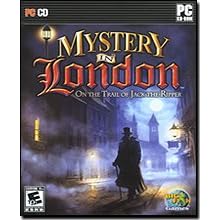
"Mystery in London" is a Hidden Object game in which you search for various things cleverly hidden in the various environments.
Even though I love Hidden Object games, what intrigued me about this game was the incredible scenes of Westminster Abbey, especially the Henry VII Chapel, Piccadilly Circus and the exterior of Buckingham Palace. Youwill be searching for objects all over London, including pubs and posh stores. The objects are very hard to find but you have the option of panning 360 degrees so you are able to swivel around with your eyes just the way you'd do in person.
You'll learn quite a bit as you do along as many interesting facts are presented, but in order to proceed you have to solve a series of mini-puzzles tied to the plot of the player's tracking down the identity of Jack the Ripper. The mini-puzzles are not very hard but you simply have to get through them. You can opt to not do a certain number of them. The plot is slightly on the weak side but it is better than the plots of most Hidden Object games.
What makes this game extraordinary is the scenes. The Henry VII Chapel alone is worth the price of the game. You also get to visit the small Peter ad Vincula Chapel where the beheaded Anne Boleyn, Katherine Howard, and Lady Jane Grey are buried under the floor. It's almost like being there! You stand there and you think "those poor queens are right under my feet!"
"Mystery in London" unlike many Hidden Object games, is not one that will appeal to children. This game is for the connoisseur, one who appreciates simply splendid panoramic graphic art. And it's perfect for the Anglophile and the lover of London.
Click Here to see more reviews about: Mystery in London: On the Trail of Jack The Ripper
Product Description:
Gather clues and challenge the locals to unearth thetruth behind a murderous pastProduct InformationYour vacation to London turns into an investigation into one of its most notorious mysteries ever in Mystery in London: On the Trail of Jack The Ripper! As a collector of old books and curiosities a leisurely trip to Long has taken a spine-tingling twist. Inside a copy of the novel Dr. Jekyll and Mr. Hyde you have found a cryptic note signed JR. Suddenly you are on the trail of Jack the Ripper one of history's most notorious killers. His identity has eluded sleuths and scholars for over a century. Can you unveil the conspiracy in 16 chapters? Investigate locations like Buckingham Palace Westminster Abby and the Tower of London for hidden objects. Use 360-degree panoramic views to spot concealed clues.Product FeaturesExplore the city through 360-degree photographs of locations such as Buckingham Palace Westminster Abbey – even the tailor shop where James Bond buys his shirts!Gather clues and challenge the locals to unearth the truth behind a murderous pastExplore realistic levelsSolve notorious mysteryMaster challenging mini-gamesWindows RequirementsWindows 2000 XP Vista800 MHz processor512 MB of RAM124 MB Hard Drive spaceDirectX 9.0CD-ROM drive
The Jack the Ripper letters: The "Dear Boss" Letter
Casebook: Jack the Ripper
Ripper Letters
(Transcription)
Ripper Letters
During the Autumn of Terror hundreds of letters were sent to the police and local press purporting to be written by the Whitechapel fiend. Most of them were deemed to be fakes written by either newspaper men trying to start a story or fools trying to incite more terror. Many Ripperologists believe them all to be hoaxes. Other experts believe some (specifically the Dear Boss letter, Saucy Jacky postcard, and From Hell letter) are genuine. A select few have been reproduced below.
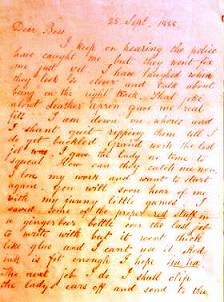
'Dear Boss' letter
Received on September 27th, 1888 at the Central News Agency, this letter was originally believed to be just another hoax. Three days later, the double murder of Stride and Eddowes made them reconsider, especially once they learned a portion of the latter's earlobe was found cut off from the body, eerily reminiscent of a promise made within the letter. The police deemed the "Dear Boss" letter important enough to reproduce in newspapers and postbills of the time, hoping someone would recognize the handwriting.
A postcard received at the Central News Agency on October 1st, making direct reference to both the murders and the "Dear Boss" letter, is believed to have been written by the same hand. It is reproduced below.
Whether or not the letter is a hoax, it is the first written reference which uses the name "Jack the Ripper" in reference to the Whitechapel murderer.
|
| ||||||||||||||||||||||||||||


| |||||||||||||
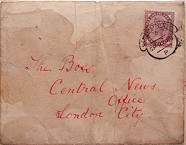
The original envelope in which the "Dear Boss" letter was sent. All photos courtesy S.P. Evans / M.E.P.O.
(Transcription)
Dear Boss,
I keep on hearing the police have caught me but they wont fix me just yet. I have laughed when they look so clever and talk about being on the right track. That joke about Leather Apron gave me real fits. I am down on whores and I shant quit ripping them till I do get buckled. Grand work the last job was. I gave the lady no time to squeal. How can they catch me now. I love my work and want to start again. You will soon hear of me with my funny little games. I saved some of the proper red stuff in a ginger beer bottle over the last job to write with but it went thick like glue and I cant use it. Red ink is fit enough I hope ha. ha. The next job I do I shall clip the ladys ears off and send to the police officers just for jolly wouldn't you. Keep this letter back till I do a bit more work, then give it out straight. My knife's so nice and sharp I want to get to work right away if I get a chance. Good Luck.
I keep on hearing the police have caught me but they wont fix me just yet. I have laughed when they look so clever and talk about being on the right track. That joke about Leather Apron gave me real fits. I am down on whores and I shant quit ripping them till I do get buckled. Grand work the last job was. I gave the lady no time to squeal. How can they catch me now. I love my work and want to start again. You will soon hear of me with my funny little games. I saved some of the proper red stuff in a ginger beer bottle over the last job to write with but it went thick like glue and I cant use it. Red ink is fit enough I hope ha. ha. The next job I do I shall clip the ladys ears off and send to the police officers just for jolly wouldn't you. Keep this letter back till I do a bit more work, then give it out straight. My knife's so nice and sharp I want to get to work right away if I get a chance. Good Luck.
Yours truly
Jack the Ripper
Jack the Ripper
Dont mind me giving the trade name
PS Wasnt good enough to post this before I got all the red ink off my hands curse it No luck yet. They say I'm a doctor now. ha ha
Jack the Ripper's Secret Confession
The Decatur Daily
JACK THE RIPPER’S SECRET CONFESSION:
The Hidden Testimony of Britain’s First Serial Killer, a very graphic and psychological look at the inspiration behind the madness of Jack the Ripper, by David Monaghan and Nigel Cawthorne.
Will DNA Cloning Finally Reveal Jack The Ripper’s True Identity?
by Olivia Van Logum
in People, March 21, 2010
An article has been published querying whether new advancements in DNA profiling will be able to finally reveal the true identity of the notorious Jack The Ripper.
At the time of writing this article, it is 122 years since the terrible Jack the Ripper murders were committed in Whitechapel, in the East End of London.
The horrific murders were so violent and disturbing that the inhabitants and newspapers of London were morbidly fascinated, and thus the Jack the Ripper legend was born.
There were 11 unsolved murders that took place between the period of 1888 & 1891 (the reign of Jack the Ripper), but only 5 are believed to be the true work of Jack.
The unfortunate victims were:
Mary Ann Nichols murdered on 31st August 1888
Annie Chapman murdered 8th September 1888
Elizabeth Stride and Catherine Eddowes both murdered on 30th September 1888
Mary Jane Kelly murdered on 9th November 1888.
Despite London Metropolitan Police assigning their finest men to investigate the grisly murders, the crimes were never solved and the identity of the notorious Jack still remains a mystery to this day.
There have been speculations and theories as to the identity of Jack, but the prime suspects of the day were:
• Montague John Druitt
• Aaron Kosminski
• Dr Francis Tumblety
• Michael Ostrog
At the time that the murders were committed, there were no forensic scientists, DNA or psychological profilers that could assist the police with solving these terrible crimes.
Nowadays the science and technology applied to solving modern day murders has improved drastically, making it increasingly difficult for someone to get away with these types of terrible crimes.
And it is through these new advancements in technology, that will finally help to identify who Jack the Ripper really was.
A breakthrough in DNA profiling was discovered by Professor Ian Findlay, called Cell Track ID.
By using this method, Professor Findlay was able to extract the DNA fingerprint from a single cell or strand of hair up to 160 years old.
Letters believing to have been written by Jack the Ripper during his killing spree, were sent to Professor Findlay, of Queensland's Griffith University.
Professor Findlay had hoped to be able to extract DNA from saliva present on the stamps attached to the letters.
If the DNA had been successfully extracted, it was to be compared against the DNA of the descendants of the Ripper suspects, and thus reveal the true identity of Jack.
Unfortunately the DNA was too badly degraded, so a full profile could not be compiled (there were insufficient DNA markers present).
However, with further developments in DNA profiling it may be possible to discover new ways of enhancing degraded DNA or even to clone degraded DNA sufficiently to be able to compile a full profile of Jack the Ripper and finally reveal who he was.
However, even if the true identity of Jack is finally revealed within my lifetime through DNA cloning, I believe that the stories of Jack will continue to live on for many more years.
in People, March 21, 2010
An article has been published querying whether new advancements in DNA profiling will be able to finally reveal the true identity of the notorious Jack The Ripper.
At the time of writing this article, it is 122 years since the terrible Jack the Ripper murders were committed in Whitechapel, in the East End of London.
The horrific murders were so violent and disturbing that the inhabitants and newspapers of London were morbidly fascinated, and thus the Jack the Ripper legend was born.
There were 11 unsolved murders that took place between the period of 1888 & 1891 (the reign of Jack the Ripper), but only 5 are believed to be the true work of Jack.
The unfortunate victims were:
Mary Ann Nichols murdered on 31st August 1888
Annie Chapman murdered 8th September 1888
Elizabeth Stride and Catherine Eddowes both murdered on 30th September 1888
Mary Jane Kelly murdered on 9th November 1888.
Despite London Metropolitan Police assigning their finest men to investigate the grisly murders, the crimes were never solved and the identity of the notorious Jack still remains a mystery to this day.
There have been speculations and theories as to the identity of Jack, but the prime suspects of the day were:
• Montague John Druitt
• Aaron Kosminski
• Dr Francis Tumblety
• Michael Ostrog
At the time that the murders were committed, there were no forensic scientists, DNA or psychological profilers that could assist the police with solving these terrible crimes.
Nowadays the science and technology applied to solving modern day murders has improved drastically, making it increasingly difficult for someone to get away with these types of terrible crimes.
And it is through these new advancements in technology, that will finally help to identify who Jack the Ripper really was.
A breakthrough in DNA profiling was discovered by Professor Ian Findlay, called Cell Track ID.
By using this method, Professor Findlay was able to extract the DNA fingerprint from a single cell or strand of hair up to 160 years old.
Letters believing to have been written by Jack the Ripper during his killing spree, were sent to Professor Findlay, of Queensland's Griffith University.
Professor Findlay had hoped to be able to extract DNA from saliva present on the stamps attached to the letters.
If the DNA had been successfully extracted, it was to be compared against the DNA of the descendants of the Ripper suspects, and thus reveal the true identity of Jack.
Unfortunately the DNA was too badly degraded, so a full profile could not be compiled (there were insufficient DNA markers present).
However, with further developments in DNA profiling it may be possible to discover new ways of enhancing degraded DNA or even to clone degraded DNA sufficiently to be able to compile a full profile of Jack the Ripper and finally reveal who he was.
However, even if the true identity of Jack is finally revealed within my lifetime through DNA cloning, I believe that the stories of Jack will continue to live on for many more years.
Literary hoaxes including the Jack the Ripper letters
STV
The Double Falsehood or the Distressed Lovers had long been written off as a clever fraud. But now Professor Brean Hammond, of the University of Nottingham, claims it was the Bard’s work after all.
Scholar Lewis Theobold claimed the play – first performed in 1727 was a lost drama by William Shakespeare.
Now Shakespeare publishers Arden concede he was right and are publishing the play with all the others.
Professor Hammond has spent 10 years trying to figure out what the truth was about the play – that the Bard probably worked with dramatist John Fletcher on.
The plot is certainly typical of Shakespeare’s work and that of other playwrights working at the time.
It contains beautiful women, both rich and poor, a posh villain, madness, a near rape and a marriage that gets interrupted.
Prof Hammond said: “Various people rubbished Theobald, one of them the poet Alexander Pope, who had a great deal of clout.
“The early consensus was that Theobald had either forged it or passed it off as written by Shakespeare when it clearly was not Shakespeare's work.”
He studied the play in detail and established it contained signature features that marked it out as Shakespeare’s.
Great literary hoaxes
Ossian poems. Ossian is the supposed author of a series of poems that around 1760 Scottish poet James Macpherson claimed to have translated from ancient sources of Scots Gaelic. At the time the works were very influential – even Napoleon was a fan. However, debate about their authenticity raged until fairly recently and it’s generally agreed that Macpherson collected folk tales to which he added his own invention.
Hitler diaries. In 1983 a German magazine published excerpts from what they claimed were the diaries of Adolf Hitler. Apparently handwriting analysis identified the writing as Hitler’s but very quickly doubts grew and they were proved to be written on modern paper.
Howard Hughes memoirs. In 1972 author Clifford Irving clamed he had co-written a biography of the reclusive film maker, aviator and philanthropist Howard Hughes. Hughes did not immediately refute the claims, fuelling speculation. However, Irving was later convicted of fraud.
Betjeman love letters. AN Wilson, biographer of Poet Laureate Sir John Betjeman was fooled by the discovery of passionate love letters supposedly from the poet to a secret mistress. However, the hoax was unearthed when someone noticed that the first initial of each sentence spelled: “Wilson is a s**t.”
Ripper letters. Jack the Ripper who murdered at least five women in the Whitechapel area of London in 1988 inspired a hoaxer who fooled newspapers at the time. Letters signed by the Ripper arrived at various newspaper offices and some were published in the hope someone would recognise the writing. Later they were thought to be forgeries, even possibly by journalists wanting to sell more papers.
The Double Falsehood or the Distressed Lovers had long been written off as a clever fraud. But now Professor Brean Hammond, of the University of Nottingham, claims it was the Bard’s work after all.
Scholar Lewis Theobold claimed the play – first performed in 1727 was a lost drama by William Shakespeare.
Now Shakespeare publishers Arden concede he was right and are publishing the play with all the others.
Professor Hammond has spent 10 years trying to figure out what the truth was about the play – that the Bard probably worked with dramatist John Fletcher on.
The plot is certainly typical of Shakespeare’s work and that of other playwrights working at the time.
It contains beautiful women, both rich and poor, a posh villain, madness, a near rape and a marriage that gets interrupted.
Prof Hammond said: “Various people rubbished Theobald, one of them the poet Alexander Pope, who had a great deal of clout.
“The early consensus was that Theobald had either forged it or passed it off as written by Shakespeare when it clearly was not Shakespeare's work.”
He studied the play in detail and established it contained signature features that marked it out as Shakespeare’s.
Great literary hoaxes
Ossian poems. Ossian is the supposed author of a series of poems that around 1760 Scottish poet James Macpherson claimed to have translated from ancient sources of Scots Gaelic. At the time the works were very influential – even Napoleon was a fan. However, debate about their authenticity raged until fairly recently and it’s generally agreed that Macpherson collected folk tales to which he added his own invention.
Hitler diaries. In 1983 a German magazine published excerpts from what they claimed were the diaries of Adolf Hitler. Apparently handwriting analysis identified the writing as Hitler’s but very quickly doubts grew and they were proved to be written on modern paper.
Howard Hughes memoirs. In 1972 author Clifford Irving clamed he had co-written a biography of the reclusive film maker, aviator and philanthropist Howard Hughes. Hughes did not immediately refute the claims, fuelling speculation. However, Irving was later convicted of fraud.
Betjeman love letters. AN Wilson, biographer of Poet Laureate Sir John Betjeman was fooled by the discovery of passionate love letters supposedly from the poet to a secret mistress. However, the hoax was unearthed when someone noticed that the first initial of each sentence spelled: “Wilson is a s**t.”
Ripper letters. Jack the Ripper who murdered at least five women in the Whitechapel area of London in 1988 inspired a hoaxer who fooled newspapers at the time. Letters signed by the Ripper arrived at various newspaper offices and some were published in the hope someone would recognise the writing. Later they were thought to be forgeries, even possibly by journalists wanting to sell more papers.
Jack the Ripper: Tabloid Killer - Revealed
The Londonist
What's on TV this week.
Wednesday 10 March 2010
Jack the Ripper: Tabloid Killer - Revealed (FIVE, 20.00-21.00)
Do let the title put you off.
We doubt much will actually be 'revealed' in this look at the relationship between the notorious east-end killer and the press.
What's on TV this week.
Wednesday 10 March 2010
Jack the Ripper: Tabloid Killer - Revealed (FIVE, 20.00-21.00)
Do let the title put you off.
We doubt much will actually be 'revealed' in this look at the relationship between the notorious east-end killer and the press.
Musical preview: Jack the Ripper in Blackburn
Students from Blackburn College have stepped back in time for their latest musical production of thriller Jack the Ripper.
Based upon the true and compelling story of the 1888 murders in the East End, Blackburn College’s main hall will be transformed into a grim Victorian London for four nights only.
This production will showcase the very best musical talent that Blackburn College has to offer with staff and students’ working tirelessly to ensure the show goes on.
Performed by a cast of 13 drama students, the show links all of the College’s departments together with a cumulative effort from textiles, music, graphic design, production and the marketing departments.
Ian Clinton, Principal at Blackburn College, said: “This is set to be an excellent production and performance and has proven to be a very ‘hands on’ experience for all crew members involved.”
* Jack the Ripper is at Blackburn College from March 2 to 5. For tickets call Student Services on 01254 292929.
Based upon the true and compelling story of the 1888 murders in the East End, Blackburn College’s main hall will be transformed into a grim Victorian London for four nights only.
This production will showcase the very best musical talent that Blackburn College has to offer with staff and students’ working tirelessly to ensure the show goes on.
Performed by a cast of 13 drama students, the show links all of the College’s departments together with a cumulative effort from textiles, music, graphic design, production and the marketing departments.
Ian Clinton, Principal at Blackburn College, said: “This is set to be an excellent production and performance and has proven to be a very ‘hands on’ experience for all crew members involved.”
* Jack the Ripper is at Blackburn College from March 2 to 5. For tickets call Student Services on 01254 292929.
JACK THE RIPPER
JACK THE RIPPER
By Marilyn Bardsley
The Case of Jack the Ripper - Perennial Thriller
Jack the Ripper! Few names in history are as instantly recognizable. Fewer still evoke such vivid images: noisome courts and alleys, hansom cabs and gaslights, swirling fog, prostitutes decked out in the tawdriest of finery, the shrill cry of newsboys - and silent, cruel death personified in the cape-shrouded figure of a faceless prowler of the night, armed with a long knife and carrying a black Gladstone bag.
— Philip Sugden, The Complete History of Jack the Ripper
By today's standards of crime, Jack the Ripper would barely make the headlines, murdering a mere five prostitutes in a huge slum swarming with criminals: just one more violent creep satisfying his perverted needs on the dregs of society.
No one would be incensed as were the respectable families of the pretty college students that were Ted Bundy's victims, or the children tortured and mutilated by John Wayne Gacy. We have become a society numbed by horrible crimes inflicted upon many victims.
Why then, over a hundred years later, are there allegedly more books written on Jack than all of the American presidents combined? Why are there stories, songs, operas, movies and a never-ending stream of books on this one Victorian criminal? Why is this symbol of terror as popular a subject today as he was in Victorian London?
Because Jack the Ripper represents the classic whodunit. Not only is the case an enduring unsolved mystery that professional and amateur sleuths have tried to solve for over a hundred years, but the story has a terrifying, almost supernatural quality to it.
He comes from out of the fog, kills violently and quickly, and disappears without a trace. Then, for no apparent reason, he satisfies his blood lust with ever-increasing ferocity, culminating in the near destruction of his final victim, and then vanishes from the scene forever.
The perfect ingredients for the perennial thriller.
By Marilyn Bardsley
The Case of Jack the Ripper - Perennial Thriller
Jack the Ripper! Few names in history are as instantly recognizable. Fewer still evoke such vivid images: noisome courts and alleys, hansom cabs and gaslights, swirling fog, prostitutes decked out in the tawdriest of finery, the shrill cry of newsboys - and silent, cruel death personified in the cape-shrouded figure of a faceless prowler of the night, armed with a long knife and carrying a black Gladstone bag.
— Philip Sugden, The Complete History of Jack the Ripper
By today's standards of crime, Jack the Ripper would barely make the headlines, murdering a mere five prostitutes in a huge slum swarming with criminals: just one more violent creep satisfying his perverted needs on the dregs of society.
No one would be incensed as were the respectable families of the pretty college students that were Ted Bundy's victims, or the children tortured and mutilated by John Wayne Gacy. We have become a society numbed by horrible crimes inflicted upon many victims.
Why then, over a hundred years later, are there allegedly more books written on Jack than all of the American presidents combined? Why are there stories, songs, operas, movies and a never-ending stream of books on this one Victorian criminal? Why is this symbol of terror as popular a subject today as he was in Victorian London?
Because Jack the Ripper represents the classic whodunit. Not only is the case an enduring unsolved mystery that professional and amateur sleuths have tried to solve for over a hundred years, but the story has a terrifying, almost supernatural quality to it.
He comes from out of the fog, kills violently and quickly, and disappears without a trace. Then, for no apparent reason, he satisfies his blood lust with ever-increasing ferocity, culminating in the near destruction of his final victim, and then vanishes from the scene forever.
The perfect ingredients for the perennial thriller.
Jack The Ripper: Overview of the East End of London 1888
From JackTheRipper.org
JACK THE RIPPER 1888
The Jack the Ripper murders occurred in the East End of London in 1888, and although Jack the ripper was only a threat to a very small section of the community in a relatively small part of London, the murders had a huge impact on society as a whole.
Despite the fact that no-one was ever brought to justice or charged with the Jack the Ripper crimes there have, over the years, been more than a hundred named suspects who may or may not have been Jack the Ripper. Some of those suspects are fascinating. Others are down right ridiculous.
Yet one thing is certain. No matter how unlikely the names of those that appear on the ever expanding list of Jack the Ripper suspects might be, the on going challenge of "nailing" the ripper has helped keep this series of crimes at the forefront of criminal and social history for almost 120 years.
But the Jack the Ripper murders also serve as a reminder of a not too distant past when a whole section of London society fought a daily battle against poverty and starvation. The Jack the Ripper site will look at the social history that lay behind the infamous Whitechapel Murders and also look at the police investigation into the killings and will provide valuable insights into the day to day lives of the men, women and children who lived through what has been termed The Autumn of Terror
Of course the murders were also the focus of a huge criminal investigation that saw the Victorian police pit there wits against a lone assassin who was perpetrating his crimes in one of London's most densely populated and crime ridden quarters.
As such the murders also provide a window through which we can watch that investigation as it unfolded. We will look at the methods the police used to try and track the killer and compare them with the methods that the police would use today. We will ask, and hopefully answer, the question why didn't the police catch Jack the Ripper?
But we will also discuss the restrictions that hampered the detectives who hunted the killer and discuss how their investigation was greatly hampered by the fact that criminology and forensics were very much in their infancy.
One of the more intriguing aspects of the Jack the Ripper murders is the amount of worldwide newspaper coverage that they generated. Journalists converged on the streets of the east End to report on the Jack the Ripper killings and were often appalled by the diabolical living conditions that they encountered.
But they also realised that these murders sold newspapers, and so they attempted to bring as much salacious detail as possible to the reading public. In so doing they turned five sordid East End murders into an international phenomena and catapulted the unknown miscreant responsible into the realm of legend.
So please enjoy the site and use it in any way that you see fit. It is our intention that the site will grow and increase as a valuable resource that can be used by teachers, students and anyone who is simply interested in either the Jack the Ripper murders or Victorian social history.
Do you have a theory on who Jack the Ripper really was?
Email: RipperAustralia@gmail.com
Click "Home" below to see all of information on this site.
If "Home" is not visible, you are viewing the entire site.
JACK THE RIPPER 1888
The Jack the Ripper murders occurred in the East End of London in 1888, and although Jack the ripper was only a threat to a very small section of the community in a relatively small part of London, the murders had a huge impact on society as a whole.
Despite the fact that no-one was ever brought to justice or charged with the Jack the Ripper crimes there have, over the years, been more than a hundred named suspects who may or may not have been Jack the Ripper. Some of those suspects are fascinating. Others are down right ridiculous.
Yet one thing is certain. No matter how unlikely the names of those that appear on the ever expanding list of Jack the Ripper suspects might be, the on going challenge of "nailing" the ripper has helped keep this series of crimes at the forefront of criminal and social history for almost 120 years.
But the Jack the Ripper murders also serve as a reminder of a not too distant past when a whole section of London society fought a daily battle against poverty and starvation. The Jack the Ripper site will look at the social history that lay behind the infamous Whitechapel Murders and also look at the police investigation into the killings and will provide valuable insights into the day to day lives of the men, women and children who lived through what has been termed The Autumn of Terror
Of course the murders were also the focus of a huge criminal investigation that saw the Victorian police pit there wits against a lone assassin who was perpetrating his crimes in one of London's most densely populated and crime ridden quarters.
As such the murders also provide a window through which we can watch that investigation as it unfolded. We will look at the methods the police used to try and track the killer and compare them with the methods that the police would use today. We will ask, and hopefully answer, the question why didn't the police catch Jack the Ripper?
But we will also discuss the restrictions that hampered the detectives who hunted the killer and discuss how their investigation was greatly hampered by the fact that criminology and forensics were very much in their infancy.
One of the more intriguing aspects of the Jack the Ripper murders is the amount of worldwide newspaper coverage that they generated. Journalists converged on the streets of the east End to report on the Jack the Ripper killings and were often appalled by the diabolical living conditions that they encountered.
But they also realised that these murders sold newspapers, and so they attempted to bring as much salacious detail as possible to the reading public. In so doing they turned five sordid East End murders into an international phenomena and catapulted the unknown miscreant responsible into the realm of legend.
So please enjoy the site and use it in any way that you see fit. It is our intention that the site will grow and increase as a valuable resource that can be used by teachers, students and anyone who is simply interested in either the Jack the Ripper murders or Victorian social history.
Do you have a theory on who Jack the Ripper really was?
Email: RipperAustralia@gmail.com
Click "Home" below to see all of information on this site.
If "Home" is not visible, you are viewing the entire site.
Did Jack the Ripper kill North woman?
Sunday Sun, UK:

He stalked the streets of London’s East End in 1888, striking terror into the hearts of all.
Now new light is being shed on Jack the Ripper . . . including a Geordie connection.
Forensic expert and retired police inspector Norman Kirtlan has been profiling the notorious Victorian serial killer and uncovered new evidence including a possible Ripper murder in the Gateshead area.

Norman has compared Victorian police methods with those used by today’s cops and has come up with some startling results.
He said: “For the past four years I have been teaching forensics throughout the UK.
“It is apparent that the interest in the Whitechapel murders has not diminished since they were perpetrated in the 1880s.
“When one of my students gave me a book by Pat Cornwell, linking the murder with artist Walter Sickert, it occurred to me that many of the theories linking everyone from the Prince Regent to American psychopath doctors were based on primitive evidence gathering and faulty forensics at the time.”
Jack the Ripper is the popular name given to the monster who killed a number of prostitutes within a mile area in Whitechapel, Spitalfields, Aldgate, and the City of London.
Cornwell presented her theory that Sickert was responsible for the murders in a book in 2002.
She claimed she was able to scientifically prove DNA on a letter attributed to the Ripper and one written by Sickert belong to only one per cent of the population.
The world over people are fascinated with the murders. The Ripper wasn’t the first serial killer, but is one of the most famous.
He was never caught and, to this day, people puzzle over who he was.
In many movies he’s portrayed as a tall man with a black coat and top hat, stalking the mists of Old Whitechapel.
But Norman warned: “Once we adopt that image we can never look at the case with an open mind.
“We have to start with a clean piece of paper and look broadly at a case that, while it happened over a century ago, still provides opportunities for discovering new evidence.
“Using modern profiling methods and examining the evidence with a completely open mind, it seems obvious that there were many flaws in the case - and the many suspects put forward by authors over the years.”
His research has led him to a Ripper-style murder, here in the North East. A week before Ripper victim Mary Kelly was murdered in her squalid room, Jane Savage was found on Birtley Fell, Gateshead, with her intestines spilled out and her throat cut.
“The Metropolitan police were terrified of this escalating,” said Norman.
“Ripper detectives from London were very quickly at the scene and discounted the possibility that the Ripper was responsible. Her lover Willy Waddell was blamed and he was hanged.
“Perhaps an innocent man was sent to the gallows as a result of the Ripper’s handiwork being discounted.”
He added: “Serial killers, we now know, travel outside of their original killing zone. The railways were regular and reliable, and if we look at Yorkshire Ripper Peter Sutcliffe - he, was mobile and at liberty to kill at will.
There were other Ripper-type murders around the country, and if the police had been wholly ethical back in 1888, we could accept that Jane Savage’s lover was the murderer. But we can’t rule out the London connection.”
Norman will be revealing more of his theories at a session called Jack the Ripper - The Truth at Gateshead Heritage@St Mary’s, at Oakwellgate, Gateshead, on March 10. It starts at 6.30pm and tickets are £2 from the box office 0191 433 6965.
He is also running a forensics course for the WEA at the Bridge Hotel, Newcastle, from September 8. For enquiries email: forensicart@yahoo.co.uk
Jack Sim - Crime writer and Ghost Hunter Australia - features on Brisbane Radio 4BC's weekly Classic Crime at 9

Visit the website of Australia's most well-known crime and murder sleuth Jack Sim:
http://www.jacksim.com.au/Pages/crime&murder.htm
Jack Sim is Australia's foremost authority on crime.
He is based in Brisbane and has a regular segment on Radio 4BC each monday night at 9.00pm EST - "Classic Crime at 9" - Australia's longest-running radio program devoted to murder and other nefarious crimes.
Listen live on 4BC at 9.00pm EST every Monday: Listen Live to 4BC

Jack Sim publishes books on some of Australia's most-notorious crimes including the infamous Betty Shanks' murder in Brisbane and the 1952 Southport Taxi Driver Killer and the 1955 Rampage of Killer Kast who fatally bombed doctors' surgeries on Brisbane's Wickham Terrace medical precinct.
Jack has investigated Australia's possible connections to Jack the Ripper which are described on this website at:
http://jack-the-ripper-1888.blogspot.com/2008/08/mystery-image-of-jack-ripper-appears-in.html
Do you have a theory on who
Jack the Ripper really was?
Email: RipperAustralia@gmail.comJack the Ripper really was?
Click "Home" below to see all of
information on this site. If "Home"
is not visible, you are viewing the
entire site.
Subscribe to:
Posts (Atom)